For web design, Webflow, Shopify, and WordPress partners
The report you hand a client who just asked what's next for SEO.
You launched their site. Now they want to know what's next for SEO, and you don't have a senior SEO on staff. StratifySEO reads the client's real Search Console and Analytics, finds the single growth blocker capping their traffic, and builds a ranked 90-day plan you can present, get approved, and bill against. No SEO specialist required.
Real report structureClient-ready languageNo signup to download the sample
What the roadmap looks like in the product
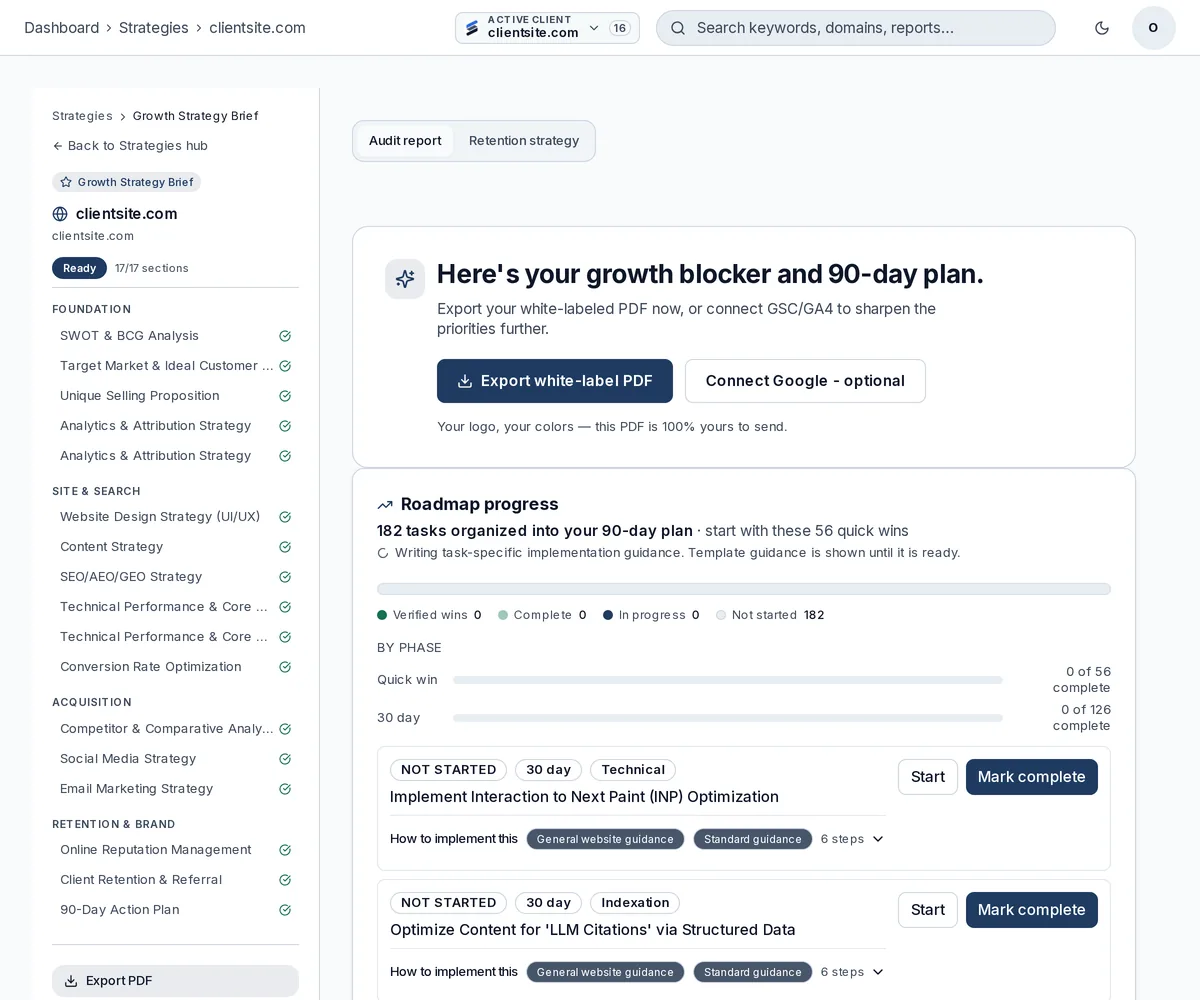
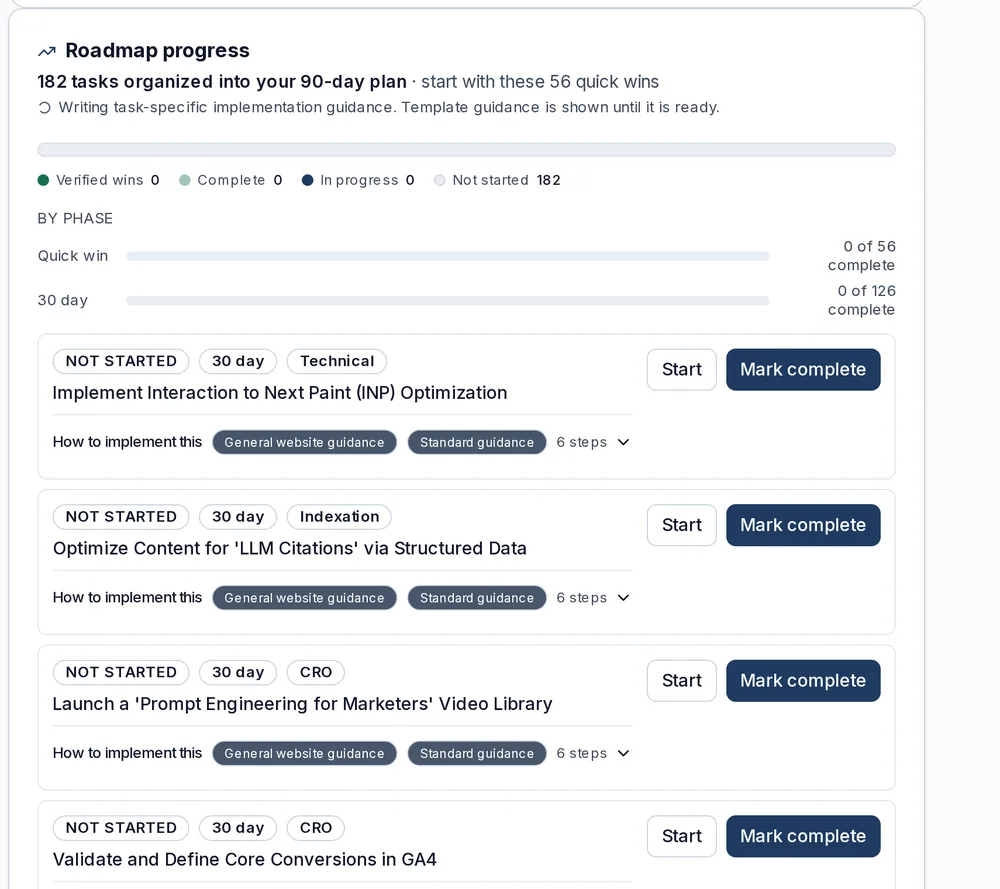
Screenshots from a live roadmap, with the client domain replaced by a placeholder. Same output the sample PDF is exported from.
The roadmap page your team works from, with every section marked ready and the client PDF one click away.Each task carries its phase, category, and implementation steps, so work can be assigned without a senior SEO translating it first.
Sample roadmap excerpt
What the client actually reads
Executive snapshot
Overall health score 62
This sample shows the roadmap a web design or platform partner hands a client after launch. The site is well built and fast, but only a third of its commercial pages are earning search impressions, and the service pages compete with each other for the same queries. The first quarter is about making the existing pages eligible and distinct, not adding more pages.
What's working
Design and performance are strong: the build scores well on Core Web Vitals and mobile usability, so no replatforming is needed.
What's costing the most
Service pages target overlapping queries and lack supporting internal links, so the strongest page rarely wins the ranking.
Top opportunities
Consolidate three overlapping service pages into one authoritative page
Redirect the weaker two and merge their proof points into the survivor.
Add internal links from the blog to the two highest-value service pages
Twelve existing posts already mention the service without linking to it.
Publish location pages for the three regions the client actually serves
Each page needs unique proof, pricing context and a local contact route.
Top risks
Forty percent of published pages are not indexed
Thin template pages are absorbing crawl budget from commercial pages.
No conversion tracking on the primary enquiry form
Without this, no SEO work in the quarter can be attributed to revenue.
Two competitors publish weekly against the client's core topics
Coverage gaps widen each month the client stays static.
Fix indexation on commercial templates
Why it matters
Forty percent of pages are excluded from the index, so they cannot rank at all.
Effort
Low
Priority score
94/100
Timing
Days 1-30
Expected outcome
More eligible pages indexed and reported in Search Console within one cycle.
How to implement this
In Google Search Console, open Indexing then Pages and review the reason shown for each important excluded URL.
Prioritize product, category, service, and key content pages. Do not automatically index cart, checkout, account, internal search, duplicate filter, or staging pages.
If the reason is "Excluded by noindex tag", open the page's SEO or advanced settings in the CMS and remove the noindex setting only if the page should appear in Google.
If the reason is a blocked robots.txt rule, redirect, 404 error, or canonical pointing elsewhere, ask the website developer to correct that specific issue before requesting indexing.
Confirm the page has useful unique content, is linked from the site, and appears in the XML sitemap if it is an important public page.
Example
If an important public page is reported as "Excluded by noindex", turn off the noindex setting for that page, publish it, and request indexing. Do not do this for cart, checkout, or account pages.
Done looks like: The important page is publicly accessible, allowed to be indexed, internally linked, and no longer shows the original blocking issue in Search Console. Monitor impressions, positions, and qualified sessions after publishing.
Consolidate overlapping service pages
Why it matters
Three pages compete for the same query, splitting authority and confusing intent.
Effort
Medium
Priority score
88/100
Timing
Days 1-30
Expected outcome
One page ranks consistently instead of three rotating in and out.
How to implement this
Compare the competing pages in Search Console over the last three months. Choose the keeper URL based on impressions, clicks, backlinks if known, conversion value, and the clearest page purpose.
Copy useful unique material from the weaker pages into the keeper: product or service details, FAQs, examples, reviews, pricing context, and images.
Rewrite the keeper page around one clear audience need and primary search phrase. Remove duplicate sections instead of simply combining everything.
Publish the improved keeper page and check that its title, main heading, and primary call to action match the selected intent.
Create a permanent 301 redirect from each retired URL to the keeper URL. Do not redirect unrelated pages to the homepage.
Example
If several pages target the same buyer search, keep the one with the strongest search visibility, move the best proof and details onto it, then permanently redirect the others to that final page.
Done looks like: One live page serves the search intent, retired URLs permanently redirect to it, and navigation no longer links to retired URLs. Monitor impressions, positions, and qualified sessions after publishing.
Illustrative sample prepared for agency review. Figures describe a fictional client site, northline-interiors.example.
Every section is designed to answer the questions decision-makers ask before they approve SEO work: what matters, why it matters, and what to do next.
Executive summary
Open every report with the growth blocker, recommended scope, and the exact work the client should approve first.
Billable Opportunity Score
Quantify impact, revenue potential, urgency, and ease so clients understand why the next phase is worth paying for.
Ranked roadmap items
Show decision-makers what to fix first, what to schedule next, and what to ignore until later.
30 / 60 / 90-day execution plan
Sequence work into phased deliverables the client can budget and your team can ship on schedule.
Source-backed data
Anchor every recommendation in GSC, GA4, PageSpeed Insights, and StratifySEO crawler signals.
Client approval page
Give decision-makers a concise scope recommendation they can share, review, and say yes to.
Web design, Webflow, Shopify, and WordPress partners use this sample in launch handovers, proposals, and renewal calls to show clients exactly what the next 90 days look like, before any scope is signed.
The sample is built from a real analysis run on the current version of StratifySEO, so the structure, scoring, and phasing match what you get today. The site it profiles is fictional and the numbers are frozen at the date the sample was generated, so treat the figures as an illustration rather than live market data.
Can I put this straight into a client pitch deck?+
Use it as a format reference, not as your client's plan. The sample is public, so the findings belong to a fictional site. Generate a roadmap for your client's own domain, then export the white-labeled PDF and lift those pages into your deck.
How does the sample compare to a roadmap generated for a real site?+
Same sections, same scoring model, same 30 / 60 / 90 sequencing. A real run differs in two ways: the findings come from your client's crawl, Search Console, and GA4 data, and the priority order shifts to match what that data shows is actually capping traffic.
Why is the sample only 14 pages when audits are usually much longer?+
Length is not the deliverable. Duplicate findings are merged into one ranked item, low-evidence observations are separated from scored work, and anything a client cannot act on this quarter is left out. What remains is the plan you present.
Is the client name in the sample redacted?+
The sample profiles a fictional site created for this walkthrough, so nothing is redacted and no client data appears. The screenshots on this page use a placeholder domain for the same reason.
Do I need an account to read the sample?+
No. The PDF downloads without a signup, and the excerpt and screenshots on this page show the same output. An account is only needed when you want to generate a roadmap for your own client domain.
Answer the post-launch SEO question like a strategic partner
The sample roadmap gives your clients clarity, evidence, and a clear scope to approve, so you spend less time chasing decisions and more time delivering work.